
Summary;
- Big airports can stay open yet run far below normal capacity, creating knock on delays and cancellations.
- A flight can be canceled in Europe because the plane and crew are out of position in North America.
- For weather cancellations, you’re typically offered rerouting or a refund, but not automatic compensation.
- The fastest move is often the airline app or website, not the phone line.
- Save screenshots and receipts for any follow up request.
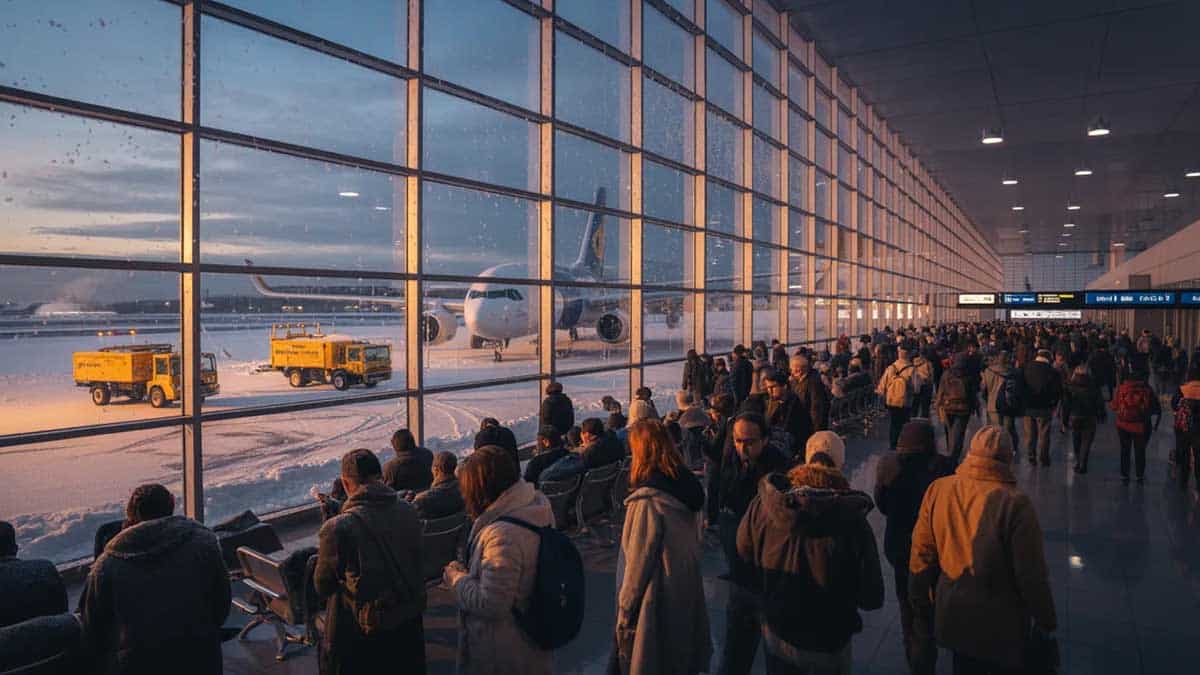
If you’re flying between Europe and North America this week, there’s a good chance Fern storm has already changed your plan. Airports in the US and Canada may remain operational, but snow, ice, and very low temperatures can slow everything down on the ground, which is where most bottlenecks begin.
This guide explains what’s happening in plain terms, why cancellations can ripple all the way to Europe, and what to do in the first hour after your flight is called off. No drama, just practical steps that help you stay moving and avoid unnecessary costs.
When airports stay open but operations still grind down
A winter storm doesn’t need to “close” an airport to cause chaos. What usually breaks the system is the ground work: runway clearing, aircraft de icing, shifting visibility, and crews struggling to reach the airport. That combination reduces how many aircraft can depart or land per hour, which triggers schedule triage across the entire network.
The ripple is strongest in large hubs. In the reference situation, airports such as New York, Boston, Chicago, Washington, Atlanta, Toronto, and Montreal are described as open, yet operating with reduced capacity. Once a hub slows, missed connections stack up and airlines start canceling flights to keep the rest of the system from collapsing. The result is often fewer flights, not just later flights, which is why you may see sudden cancellations.
“It’s sunny in Paris, why is my flight canceled?”
This is the most frustrating part, and it’s also the easiest to explain. Airlines plan aircraft in rotations. Your outbound flight might depend on an aircraft that was supposed to arrive from North America earlier that day. If that aircraft is delayed by snow operations or parked with nowhere to go, it can’t magically appear for your departure. Crews face similar constraints, including legal duty time limits, which can wipe out a flight even when the weather at your origin is fine.
That’s why a Paris to New York or Paris to Toronto flight can be canceled even if Europe has clear skies. The issue is often aircraft positioning, not your local forecast. A useful check is to look at the inbound flight number, the one meant to arrive before your departure, because it often tells the real story.
The first hour after a weather cancellation: do this in order
When cancellations spike, phone lines overload and airport desks turn into long lines. The calm, effective approach is to do fewer things, but do them fast and in the right order.
Start by confirming the cancellation in the airline app or on the website. Then look for rerouting options. In weather events, airlines generally offer rerouting or a refund depending on whether you still want to travel. Compensation is usually not automatic for severe weather, but you should still be offered a clear choice between alternative travel and getting your money back.
Next, save proof. Take screenshots of the cancellation notice, the alternatives offered, and any messages from the airline. If you spend money because you’re stranded, keep every receipt for meals, ground transport, or accommodation. Even when policies vary by carrier and availability, documentation is your best leverage later.
Where to check, who to call, and what to keep
In disruption mode, the airline app is often your fastest tool for rebooking, especially if travel waivers or flexible change windows are active. Check official channels first, because social media and third party trackers can lag behind real inventory. The key habit is to check status before leaving for the airport, because showing up “just in case” is a reliable way to lose hours.
Here are the official sites mentioned for real time updates: Air Canada, United Airlines, and Delta Air Lines. If you need phone support, these numbers are commonly provided in the reference context: Air France +33 9 69 39 36 54, Air Canada +1 888 247 2262, United +1 800 864 8331, Delta +1 800 221 1212. Keep these in your notes so you don’t have to hunt them down when stress is high, and focus on one channel at a time so you don’t duplicate work.
Why disruption can last beyond the forecast
Even when the weather improves in one place, airlines still need time to reposition aircraft and crews, and to absorb passengers already stranded in the system. Think of it as rebuilding a schedule from broken pieces: planes are in the wrong cities, crews are out of sequence, and airports are still catching up on backlogs.
So the practical strategy for the next couple of days is simple. Check your flight status regularly, act early if a free change option appears, and stay flexible about routes. Sometimes the fastest path is not your original direct flight, but a realistic reroute that gets you there with fewer moving parts. The goal is not perfection, it’s getting there.