
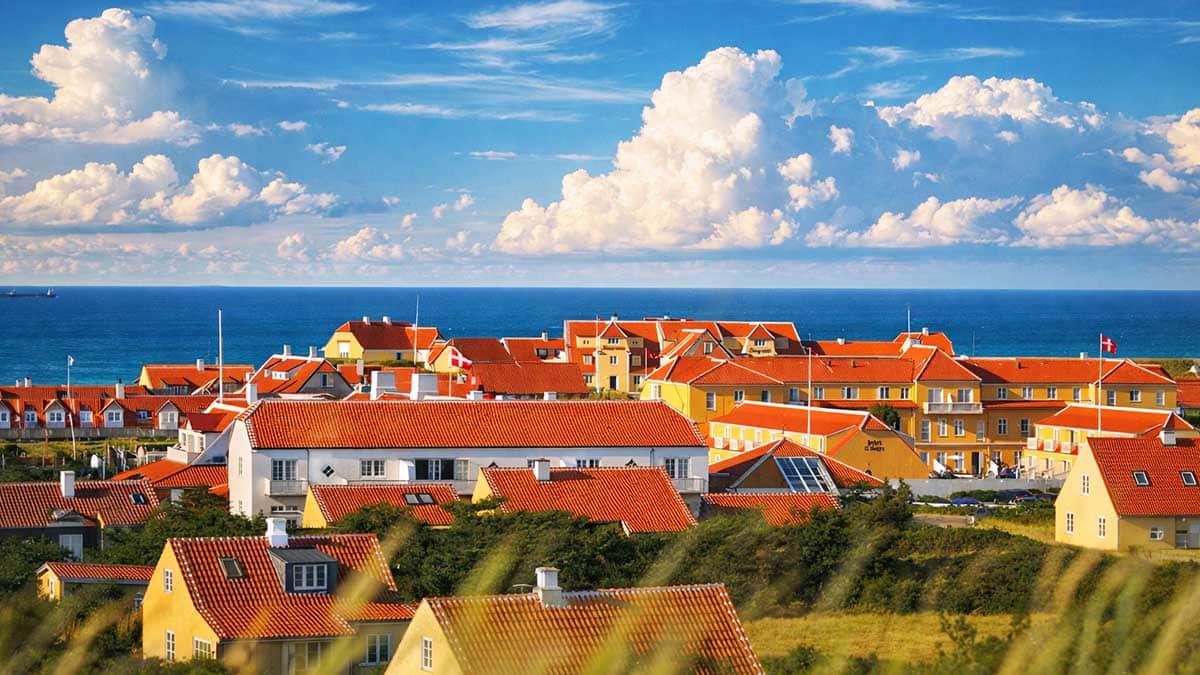
Summary:
- See why Skagen’s light keeps drawing artists and photographers back.
- Understand how distance and weather shaped daily life here.
- Discover what really happens where two seas meet.
- Get a feel for Skagen beyond the summer crowds.
Skagen is not the kind of place that grabs you instantly. At first, it feels quiet, almost restrained. Low houses, calm streets and shifting light define the first impression. Nothing asks for your attention, yet everything rewards it if you stay long enough.
Set at the very tip of the Jutland peninsula, where the North Sea meets the Baltic, Skagen has always lived slightly apart. Geography shaped how people worked, traveled and observed the world here. This article looks at Skagen as it is, a town defined by its surroundings and its pace.
A town that feels further than the map suggests
Reaching Skagen today is easy. Feeling how far it is takes longer. For centuries, the town stood isolated behind dunes and shifting sands, dependent on the sea and the weather.
That distance still shapes the place. Endless beaches, moving dunes and open horizons structure daily life. You are never far from space, and rarely surrounded by noise.
What this changes for visitors
- You notice landscapes before landmarks.
- Walking and cycling feel more natural than rushing.
- Plans adapt to weather conditions, not schedules.
Skagen doesn’t reward speed. It favors attention.
When painters came North for the light
In the late nineteenth century, Skagen began attracting artists for a simple reason. The light behaved differently here. Long summer evenings softened contrasts and extended working hours outdoors.
Artists such as Peder Severin Krøyer, Anna Ancher and Michael Ancher focused on ordinary scenes. Fishermen at work, shared meals, quiet interiors. Their paintings relied on observation rather than staging.
They did not arrive with a manifesto. What linked them was the place itself. Skagen offered time, light and proximity to daily life.
A useful stop today
Former artists’ homes remain open to visitors. They feel modest, practical and lived in, closer to workspaces than monuments. Together with the Skagens Museum, they explain why this place mattered.
Life built around the sea, not the view
Long before Skagen became a destination, the sea was a workplace. Fishing here meant risk, cold and uncertainty. Shipwrecks were common, and survival depended on collective effort.
That past has not been polished away. The harbor is still active, fishing boats unload daily, and local museums focus on rescues and routines shaped by tides.
Everyday moments tied to the coast
- Watching boats return late in the afternoon.
- Eating fresh seafood, prepared simply.
- Walking beaches where swimming requires real caution.
The sea remains present, practical and sometimes unforgiving.
Grenen, where the landscape refuses to stand still
Just north of town lies Grenen, Denmark’s northernmost point. Here, the North Sea and the Baltic meet without blending smoothly. Currents cross, waves collide and the shoreline shifts.
Reaching the tip takes effort, either on foot or by tractor shuttle. That distance matters. It preserves the sense of scale and exposure, especially early in the morning or near sunset.
Birds migrate through the area, and seals are sometimes visible along the shore.
Before you go
| Practical note | Why it matters |
| Visit early or late | Fewer people, clearer sense of scale |
| Avoid swimming | Strong, unpredictable currents |
| Dress for wind | Conditions change quickly |
Grenen offers no attraction beyond itself. That is precisely the appeal.
Skagen today, without trying too hard
Despite its reputation, Skagen rarely feels busy outside peak summer weeks. Daily life continues at a steady pace, and visitors tend to blend in rather than dominate the space.
Cycling remains the easiest way to explore. Quiet roads connect beaches, villages and open land. Cafés, galleries and breweries favor atmosphere over display.
A short ride away, Gammel Skagen faces west. People gather there in the evening for one reason only, the light as the sun lowers over the sea.
Skagen does not reinvent itself. It does not need to.
Skagen leaves room for interpretation. It offers light, space and continuity, not highlights to collect.For travelers who value calm places and honest landscapes, it remains present long after the journey ends.