
Summary:
- How this Alpine glacier formed and why it continues to move.
- What its retreat reveals about past climates.
- Where to find calm, scenic viewpoints.
- Wildlife and plants thriving near the ice.
- Practical tips for a safe, respectful visit.
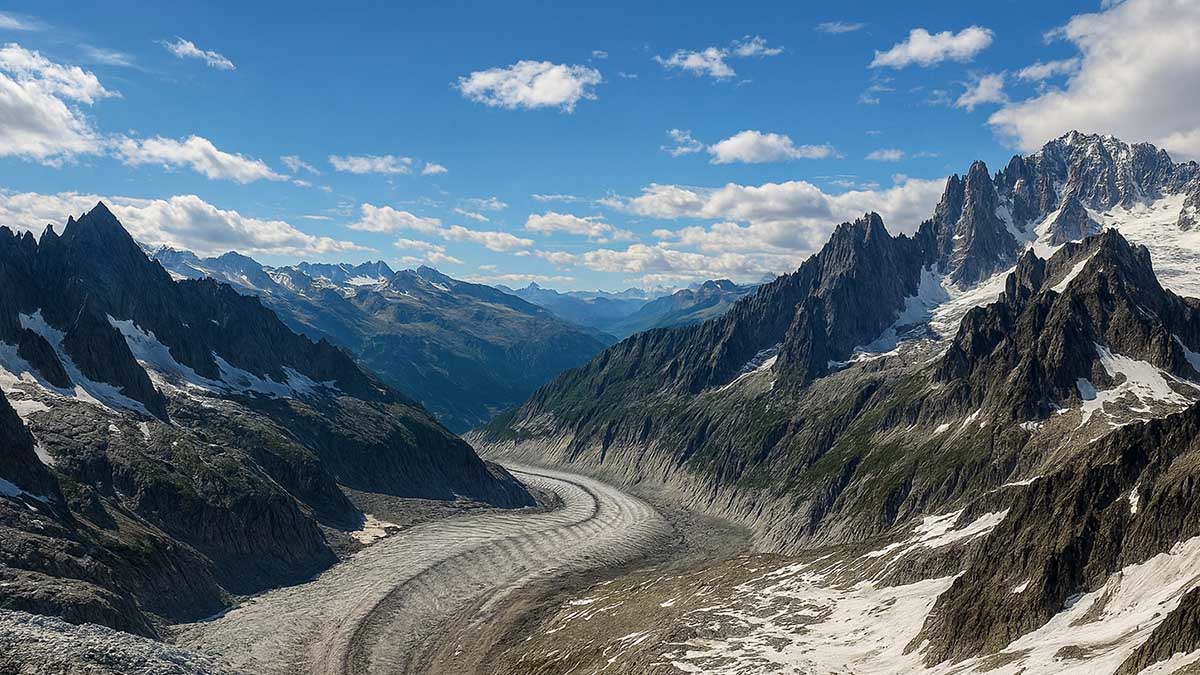
On the northern side of the Mont Blanc massif lies a glacier that looks nothing like the postcard version of the Alps. The closer you get, the more its fractured ridges and blue crevasses resemble a wild northern ice field. You expect a still landscape, yet everything around you whispers movement, even in the middle of summer.
This article walks you through the essentials, how the glacier forms and shifts, what scientists uncover there, and how to explore it at a gentle pace. You will also find observations from the ground, from wildlife to thin bands of fresh vegetation, helping you read this icy world as a living part of the mountains.
When ice decides to move on its own time
Even when it looks perfectly still, the glacier keeps sliding downhill at a slow, steady pace. Snow from three high basins compresses into ice and pushes the entire mass forward, a natural conveyor belt carrying fragments of rock and gravel. On the surface, long dark stripes move slightly each year as the glacier adjusts to temperature and terrain.
Crevasses open and close as the surface stretches, creating patterns that shift with the seasons. The ice adapts to cliffs and ridges like a tide that refuses to stay still, a reminder that glaciers are constantly reshaping their own path.
How snow becomes a slow river
Decades of snowfall compact into dense ice that flows almost like a liquid. As gravity pulls it downhill, the surface cracks and reforms, which is why experienced guides check the terrain regularly. A safe route one year may look entirely different the next.
Traveler’s note
If you pause on a quiet ledge above the valley, you may hear faint clicks echoing through the ice, a small sign of the glacier’s endless internal motion.
Reading the glacier like a climate time capsule
Beyond its beauty, the glacier preserves traces of past winters and ancient air pockets. For researchers, it acts as a natural archive containing rare climate clues.
What researchers look for
Scientists track the glacier’s thickness, melting rate and changes in its lower front. Newly exposed rock faces reveal former ice levels, their striations acting like markers of previous centuries. A century ago, some of these now bare areas were still buried under several dozen meters of ice.
A valley redrawn by retreat
As the glacier pulls back, it reveals polished rock and thin layers of sediment that settle once the ice melts. These fresh surfaces create a more textured reading of the valley, mixing raw geology with young patches of alpine vegetation.
What this means for you
- Older maps rarely match the glacier’s current shape.
- The look of the valley changes noticeably from one summer to the next.
- Guides know which zones remain stable in warm weather.
Life at the edge of ice, tougher than it looks
At first glance, the area feels too stark for life. But look closer and you will notice birds gliding overhead, agile animals crossing steep slopes, and tiny flowers anchored in gravel, each species finding its own way to survive in thin air and sudden weather shifts.
Animals to watch for
- Bearded vulture, often gliding high above the valley.
- Chamois and ibex, agile on steep rock faces.
- Ptarmigan and black grouse, perfectly camouflaged against stone or snow.
These animals are most active at dawn and dusk, when the valley is quieter.
Plants finding their chance
When the ice withdraws, the ground is unstable and barren. Yet pioneer flowers soon appear, small but resilient, slowly forming delicate ribbons of green against the mineral backdrop. Their presence signals the first steps of natural recolonization.
Local tip
Late afternoon often brings softer light and fewer visitors, making it easier to observe both wildlife and the subtle colors of the valley.
Why travelers have been coming here for generations
Long before modern tourism, naturalists climbed into this valley to understand how ice shapes mountains. Their early notes helped outline the first theories of glacier movement.
From curiosity to mountain tourism
In the 19th century, travelers visited the glacier with experienced local guides. Later, the arrival of a rack railway made access easier, turning the area into a popular viewpoint for families, hikers and curious visitors who wanted to see the glacier without demanding climbs.
Budget insight
Avoiding peak weeks makes the visit more peaceful and often more affordable. Clear weather days reveal far more detail on the ice surface.
Making the most of your visit without rushing
The glacier is surprisingly accessible, and a bit of preparation enhances the experience. Each viewpoint offers a different angle on the valley’s evolving landscape.
The best spots to take it all in
| Viewpoint | Access | What you will see |
| Upper terrace | Train or trail | Broad panorama of crevasses and flow lines |
| Lateral moraine ridge | With a guide | Retreat markers and sediment layers |
| Lower valley | Hiking path | Contrasts between ice, rock and vegetation |
Staying safe on unpredictable ground
- Wear sturdy shoes for uneven terrain.
- Pack a warm layer, even in summer.
- Walk on the ice only with a certified guide.
- Check weather updates before leaving.
What this means for you
With a bit of planning, the visit stays calm, accessible and deeply rewarding. The glacier shifts quickly, yet that constant change is part of what makes the experience feel so alive.
Exploring this glacier is more than ticking off a viewpoint. It is a chance to see the Alps moving at their own pace, with ice that cracks, rocks that reappear and wildlife that adapts. The experience stays with you because it feels honest, grounded in the present moment, offering a direct encounter with the mountains.
Still curious about quieter Alpine corners? There is always another ridge to explore.