Show summary Hide summary
Summary :
- A handpicked list of iconic and meaningful snowy summits.
- What makes each mountain visually or culturally unforgettable.
- When and where to enjoy the clearest, most striking views.
- A blend of famous giants and quieter gems worth seeking out.
Snow-covered mountains have a way of grabbing your attention before you even realize it. A sharp ridge catching the first light of the day or a glacier that seems frozen mid-movement can create scenes that stay in mind for years. Even from afar, the contrast between snow and sky forms a natural theater that shifts constantly. As dusk approaches, the colors soften, shadows stretch across the valleys, and the landscape feels as if it is holding its breath. These moments, suspended and quiet, often become unexpected memories and anchors in time.
Ce guide réunit des sommets connus, d’autres moins attendus; tous partagent ce pouvoir d’éveiller un regard plus attentif. Some require long treks, others appear from a lakeshore or a roadside viewpoint. There is no single way to discover a mountain, only the feeling it creates when it finally reveals itself. This is not about records but about presence, about letting these landscapes speak with their own quiet authority and timeless rhythm. Let’s take a closer look.
Bhutan: the country that quietly slows you down (and you’ll thank it for)
Europe in 2026: the trips worth planning around real dates
1. Sky giants that redraw the horizon
Everest: where the air begins to thin (Nepal, Tibet)
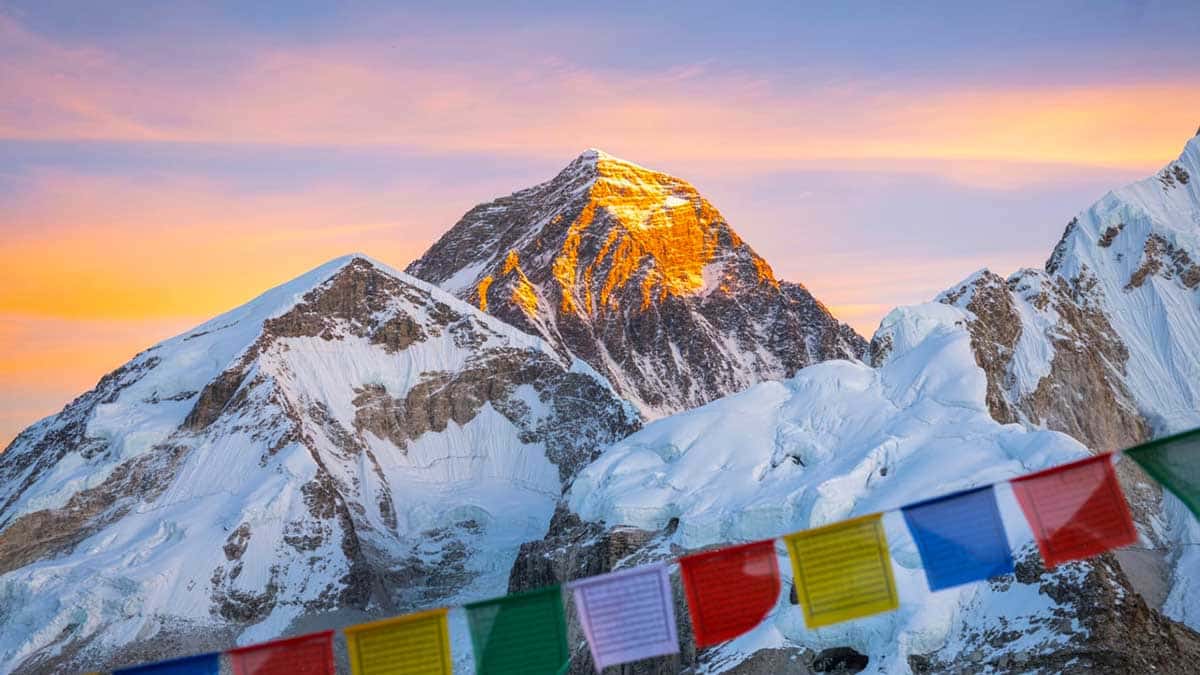
At 8,850 m, Everest dominates everything around it. Travelers who approach Kala Patthar or the Base Camp trail often speak of the moment they first saw its unmistakable pyramid rising behind lesser peaks. The route is lined with prayer flags, stone walls, and villages where life moves at a slower pace. Everest’s story began long before the first ascent in 1953 by Edmund Hillary and Tenzing Norgay; today, visitors feel moved by the sheer immensity and the quiet dignityof the mountain itself.
What this means for you
- Best seasons: April to May and October to November
- Ideal for: sunrise viewpoints, Himalayan panoramas, Sherpa culture
K2: the sharp-edged monarch of the Karakoram (Pakistan, China)
K2, rising to 8,611 m, offers a presence that feels almost sculptural. Its steep ridges and triangular silhouette create a sense of awe that few mountains match. Approaching the Baltoro Glacier feels like walking along a frozen river carved over centuries. When you reach Concordia, the convergence of surrounding peaks forms a natural amphitheater that fills the air with a sense of vastness and deep silence.
Traveler’s note
- Concordia and the Baltoro Glacier offer unparalleled perspectives.
2. Frozen frontiers of the Americas
Denali: Alaska’s towering white sentinel (USA)
Denali emerges abruptly from the tundra, rising to 6,193 m with an imposing presence. One moment you are crossing open plains; the next, the mountain appears like a massive wall of snow and light. Inside Denali National Park, the scale becomes overwhelming. Wildlife such as caribou, marmots, or occasionally bears cross the valleys, adding movement to a landscape otherwise ruled by icy stillness and huge open horizons.
Local tip
- Scenic flights from Talkeetna offer the best aerial views; mornings are often clearer.
Fitz Roy: Patagonia’s jagged lighthouse (Argentina, Chile)
Fitz Roy, with its 3,405 m granite spires, rises sharply above the Patagonian plains. The massif glows in shades of pink and orange at sunrise, a spectacle that draws photographers and hikers year-round. The trails around El Chaltén reveal new angles at every turn. The region’s wind, known for its intensity, adds character to the scenery, reinforcing the sense of raw wilderness and untamed beauty that defines Patagonia.
3. Cultural peaks with a memory
Mount Fuji: the still perfect cone (Japan)
Fuji owes much of its charm to its symmetry. At 3,776 m, the mountain rises with a calm and graceful silhouette that feels familiar even on a first visit. Whether seen from a lakeshore or a train window, Fuji inspires travelers to slow down. Around the Fuji Five Lakes, traditional inns and quiet paths offer peaceful moments where the mountain reveals its gentle atmosphere and timeless presence.
Best times to admire it
- Winter for crystal-clear views
- Lake Kawaguchi: ideal for reflections and sunrise shots
Mount Ararat: the solitary watchtower (Turkey)
Ararat stands at 5,137 m and often cloaks itself in shifting clouds that reveal and hide its snowy dome. Stories surrounding the mountain have traveled through generations, especially the reference to Noah’s Ark. Even without the legend, Ararat’s isolated shape and high plateau location give it a mysterious aura and a quiet magnetism that mark the landscape deeply.
Elbrus: Europe’s silent white dome (Russia)
Elbrus, at 5,633 m, dominates the Caucasus with a smooth, snow-covered volcanic dome. From the valleys, it appears enormous yet surprisingly soft. The contrast between its gentle slopes and the rugged peaks around it reinforces its singular shape and its striking white mass.
4. High-altitude wonders you do not expect
Parinacota: the perfect Andean curve (Chile)
Parinacota rises to 6,348 m with a symmetry that seems almost deliberate. The volcano overlooks the altiplano of Lauca National Park, where llamas, blue lakes, and dry grasslands form the backdrop. Under clear skies, the contrast between the summit and the deep Andean blue creates a surreal palette and unmistakable visual harmony.
The Tatras: a compact alpine world (Poland, Slovakia)
The Tatras may be modest in height, but they deliver striking character. Steep ridges, wooden chalets, and winter forests shape an atmosphere that feels both familiar and distinctive. The region’s folklore, mixed with accessible trails and frozen viewpoints, offers a welcoming alpine entry point and a rich cultural flavor.
5. Where the north glows and the earth rises
Lofoten Islands: peaks rising straight from the sea (Norway)
Reynisfjara right now: what changed on Iceland’s black sand beach
Europe’s 2026 travel shortlist: Madeira, Tbilisi, Milan, Glasgow
In Lofoten, snowy peaks rise directly from the ocean, creating one of the world’s most unusual mountain-sea panoramas. Winter light paints the landscape in muted blues and soft pinks, while fishing villages on stilts add warmth to the scenery. Standing near the shore at dusk means feeling Arctic serenity meet dramatic mountain intensity.
The Tibetan Plateau: the land of high horizons (China, Tibet)
The highest plateau on Earth stretches endlessly with plains, ridges, and distant peaks. The dry air sharpens outlines, giving the impression that everything is closer and further at once. Monasteries perched on hillsides punctuate the scenery, making each viewpoint a blend of spiritual presence and immense natural space.Chaque montagne de cette liste invite à un autre rythme, une autre manière d’observer. Certaines impressionnent par leur taille, d’autres par leur silence ou leur lumière. Whether discovered on a quiet morning walk or after days on a trail, these snowy peaks tend to linger in the mind and shape the memory of the journey long after you return.