
Summary:
- Five sites that bring Tunisia’s long past into the present.
- What makes each stop distinct and easy to explore.
- Practical tips to avoid the midday heat and crowded hours.
- How to enjoy each place at your own pace.
Many travelers come to Tunisia for the beaches or the desert, but the country holds something just as compelling, traces of entire worlds left in daylight. Walking through these sites does not feel like visiting a museum. It feels more like entering a space where life simply paused, leaving behind stones, streets and small details that quietly tell their story. The silence, the light and the wide landscapes often do as much as the ruins themselves.
This guide brings together five places that each offer a different doorway into Tunisia’s past. Rather than overwhelming you with dates, it focuses on atmosphere and simple context, the type of observations you would naturally share with a friend. The goal is to give you enough to prepare without boxing in your curiosity. Let’s dive in.
1. Dougga: a hilltop city you can still walk through
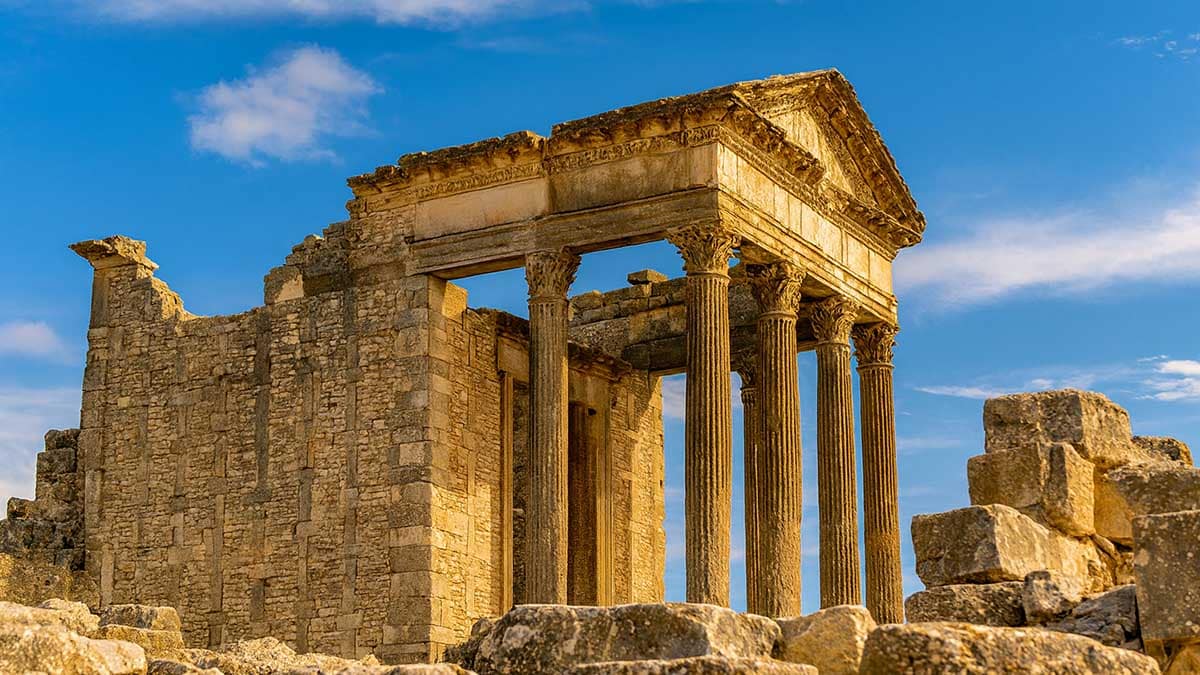
Dougga is often described as one of the best-preserved Roman cities in North Africa. Set on a hillside overlooking a wide valley, the ruins stretch far enough to let you wander freely. The view alone is worth the trip, especially when the morning light softens the stone and reveals the outlines of the theater and the Capitol.
Look closely and you will spot smaller elements: olive presses cut into the ground, carved inscriptions on stone blocks, cisterns nestled along the slope. These fragments make Dougga feel lived-in rather than staged. Because the site is extensive, you will often find entire sections empty, which makes it easier to imagine the daily rhythms that once filled the city.
What to see
- The Capitol overlooking the forum
- The theater occasionally used for cultural events
- Mosaic floors inside residential areas
- Cisterns and communal water systems
Local tip
Arrive early and bring water. Shade is limited, but the cooler hours make exploration far more pleasant.
2. Neapolis: a city caught between land and sea
Neapolis is a place where history and shoreline meet directly. A part of the city sank after an ancient earthquake, leaving one section underwater and the other near today’s Nabeul. Standing there, you hear waves crashing close to the ruins while outlines of garum production basins appear in the rocky ground.
These carved basins offer a vivid link to the activity that shaped the city’s economy. Walking from one basin to another gives you a sense of scale and organization. The seaside setting adds a natural calm, making it easy to linger and take in the details.
Why it matters
Neapolis was a major production center for garum, a prized seasoning in Roman cuisine.
What this means for you
Start your visit at the Nabeul museum, where mosaics and recovered objects provide context before you explore the coastal ruins. It is especially useful if you like to understand how a site worked rather than just look at stones.
Bulla Regia: homes built for the heat, not against it
If you enjoy distinctive architectural ideas, Bulla Regia is a fascinating stop. Its two-level houses combine an upper floor with underground rooms designed to stay cool during the hottest months. This layout has kept many mosaics in excellent condition, and stepping into these sunken rooms reveals a surprising drop in temperature.
The site also features public baths, a forum and remains of temples that help sketch the shape of the city. Because many structures remain identifiable, Bulla Regia is one of the most intuitive places to explore without a guide. The underground spaces add a quiet, almost intimate mood that stands apart from other ruins in Tunisia.
Highlights
- Underground rooms in villas such as the House of the Hunt
- Mosaics illustrating domestic life and mythology
- Baths and an amphitheater above ground
- Clear examples of design shaped by climate needs
Traveler’s note
Even in summer, the subterranean rooms stay cool. It is a great option for travelers who prefer shade and shorter exposures to the sun.
Kerkouane: a Punic city preserved against all odds
Kerkouane is the only Punic city in the Mediterranean that was never rebuilt by the Romans. Perched on a cliff in Cap Bon, it offers a striking view over the sea and a readable grid of streets and houses. This clarity makes it easy to picture how the town once functioned.
Many houses reveal traces of everyday life: thresholds, water channels, storage pits and workshops linked to dye production. Unlike Roman sites, the architecture here reflects Punic habits, giving the visit a refreshing and distinct feel. The calm surroundings and sea breeze only add to the experience.
What to expect
- A clear grid of streets and preserved domestic spaces
- A small museum with ceramics and purple dye shells
- Quiet coastal paths
- Workshop remains offering clues about the town’s economic activity
Budget insight
Entrance fees are low and the site is rarely crowded. Bring snacks or water, as nearby services are limited, which adds to the charm but requires a bit of planning.
Kairouan’s Great Mosque: ancient stones in a sacred setting
The Great Mosque of Kairouan blends faith and craftsmanship with remarkable subtlety. Built in the 7th century, it incorporates hundreds of older Roman and Byzantine columns, each one slightly different in color, size or carving style. The result is a forest of stone that reflects centuries of reuse.
The square minaret rises over a wide courtyard paved with stones polished by countless footsteps. Even from the visitor-accessible areas, the play of light on the columns and the quiet atmosphere make it easy to appreciate the scale and detailof the structure.
Key elements
- Over 500 reused marble, granite and porphyry columns
- A square minaret with a distinctive silhouette
- Carved capitals showing earlier sculptural styles
- A large courtyard that is ideal for photography and observation
Local tip
Non-Muslims can access the courtyard and observe the architecture from designated areas. Late afternoon light is especially soft.These five sites offer a different way to experience Tunisia. They reward unhurried exploration and an attentive eye, whether you are wandering through ruined streets or pausing on a quiet terrace overlooking the sea. Explore them at your own rhythm. The most memorable moments are often the simplest ones.