
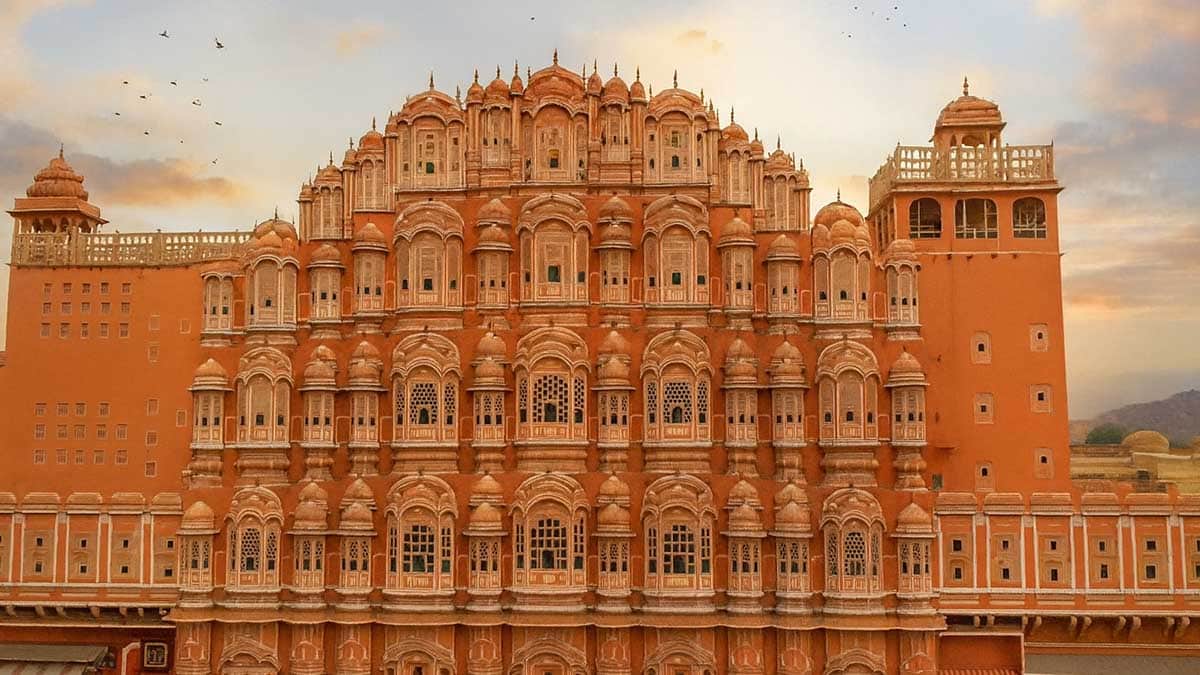
Summary:
- How the Hawa Mahal let royal women watch city life unseen.
- The airflow design that earned it the name “Palace of Wind”.
- Why its façade stands apart in Rajput architecture.
- How the 2006 restoration changed the monument’s appearance.
Travelers arriving in Jaipur often spot the Hawa Mahal rising above the old town like a lacework screen. Its five slender levels and hundreds of tiny windows seem almost weightless, as if the slightest breeze could slip through them. Yet this refined façade served a very grounded purpose when it was built in 1799: offering the women of the royal household a discreet view of the city without stepping into it. The building balanced court rules and curiosity in a way that still feels striking today.
Look closer, and the monument reveals more than a graceful outline. Its shape, materials and thin structure reflect a way of building adapted to both climate and custom. The Hawa Mahal was never designed as a royal residence but as a purposeful lookout. This article explores what lies behind the façade, how its airflow works and what recent renovations changed. Understanding these elements gives the palace a richer meaning. Let’s dive in.
Watching the city without being seen
When Maharaja Sawai Pratap Singh commissioned the Hawa Mahal, the intention was simple: give royal women a safe vantage point over Jaipur’s streets. This need influenced everything, from the building’s height to the number of openings carved into its surface.
A façade designed as a one-way screen
The jharokha, small screened windows, acted as a visual filter. From the inside, women could follow street life freely. From the outside, the public saw only a patterned sandstone wall. The architect chose to use the façade itself as an observation tool rather than relying on hidden corridors.
Traveler’s note
Many visitors expect grand reception halls. In reality, the Hawa Mahal is a narrow viewing pavilion, not a ceremonial palace.
A pink sandstone symbol with a meaningful shape
If the Hawa Mahal is instantly recognizable, it is largely because of its tapered outline inspired by the crown of Krishna. The façade shifts color throughout the day as the sandstone catches varying light.
A honeycomb of nearly a thousand openings
The 953 windows create a repeated pattern that resembles a delicate beehive structure. This rhythm gives the building its distinctive texture and is a hallmark of Rajput design.
Local tip
Morning light enhances the warm pink tones, while late afternoon reveals the sculptural carvings.
The airflow that earned the name “Palace of Wind”
The name is not poetic exaggeration. It describes exactly what the structure was meant to do.
A tall, narrow layout that lets air move freely
Because the Hawa Mahal is unusually thin, breezes travel easily through its many openings. The jharokha let air enter gently, while the ramps and open floors help circulation. This created a naturally cooler environment for the royal women during Rajasthan’s harsh summers.
What this means for you
Stand near the façade today and you still feel a soft, steady draft, a quiet echo of the palace’s original purpose.
A modest interior behind ornate stonework
The interior surprises visitors with its simplicity. The Hawa Mahal was built for use, not for show.
Ramps for moving palanquins
The upper floors are long rooms connected by ramps so attendants could move palanquins smoothly. The design prioritised practical movement over decoration.
Traveler’s insight
You won’t find elaborate murals here. The value lies in understanding how space shaped daily life, not in ornamental abundance.
A restoration that raised questions
In 2006, the Hawa Mahal underwent major restoration. Some decisions still spark debate among conservation experts.
Visual changes that shifted the original feel
Colored glass replaced some window openings, and LED lighting was added behind the jharokha. These choices gave the palace a more contemporary appearance at night. Inside, plaster and polycarbonate sheets were used to protect surfaces from damage.
A debate about fidelity more than cost
Historians argued the priority should be stabilisation, not visual transformation. Their main concern was preserving the monument’s authentic texture rather than its budget, which reached around 45 million rupees.
The Hawa Mahal is more than a photogenic backdrop in Jaipur. Its design reflects the rhythms of the city, the rules of the royal court and the realities of Rajasthan’s climate. Knowing why it was built and how it works gives the visit deeper meaning. And while travelers flock to photograph its façade, the real story sits behind the windows, where generations once watched the city unfold below.