
Summary
- The untold story of Japan’s first immigrants to Brazil.
- Why Liberdade became the beating heart of Asian culture in São Paulo.
- The local spots that capture the district’s spirit.
- How tradition and modern life still share the same streets.
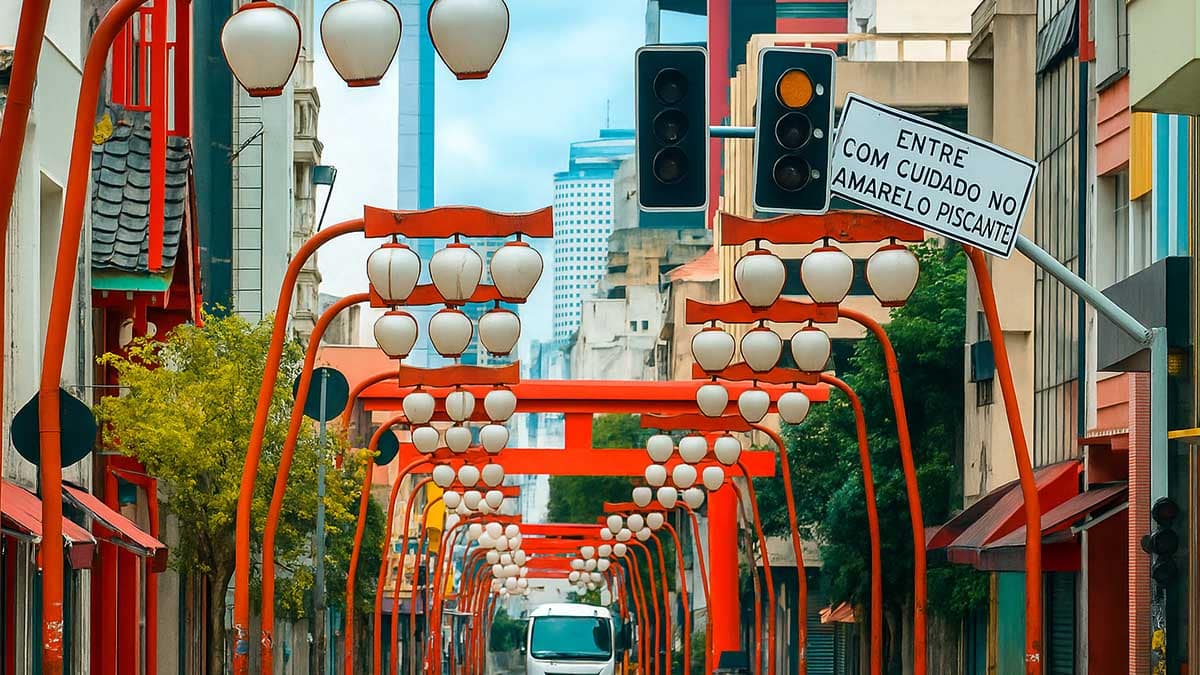
Step out of the metro at Liberdade Station and you might wonder if you’ve taken the wrong train. The red torii gates, kanji shop signs and the smell of soy broth make it feel like Tokyo met São Paulo by accident. Yet this isn’t imitation, it’s a story written by generations who brought their memories across the ocean.
What began as a small Japanese enclave in the early 20th century has turned into a kaleidoscope of Asian cultures. Today, Liberdade is where bao buns sit next to pastel de nata, and where you can sip matcha beneath a tropical sun. The hum of conversation, the blend of languages and the rhythm of city life merge into something unmistakably Brazilian, yet deeply Asian.
Roots and arrival: how Liberdade was born
It all began in 1908, when the ship Kasato Maru docked in Santos carrying hundreds of Japanese families hoping for a new start. Most settled in São Paulo, drawn by fertile land and the promise of work. They arrived with little more than seeds, discipline and hope.
In those early years, many worked on coffee plantations before moving into the city. Around Praça da Sé, they opened grocery stores, bathhouses and noodle shops that felt like home. Even as generations adapted to Brazil’s warmth and rhythm, they preserved a quiet respect for education, family and perseverance.
Their children later became students, artists and entrepreneurs. Sundays remained sacred, family gatherings over sushi, laughter in mixed Portuguese and Japanese. What was once an immigrant refuge slowly became the foundation of a new, shared identity.
From little Tokyo to pan-Asian pulse
Walk through Galvão Bueno Street today and you’ll hear four languages in as many steps. Vendors call out prices, music drifts from cafés and the smell of sesame oil fills the air. The neighborhood has grown beyond its roots, turning into a crossroads for Korea, China and Southeast Asia.
Every July, during the Tanabata Matsuri, the streets bloom with paper wishes and laughter. The Festival of Oriental Culture brings crowds for dance, music and street food. Cultural exchange happens every day, in language schools, in cafés where students talk about anime and K-pop, or in families who switch between Portuguese and Japanese mid-sentence.
Liberdade doesn’t cling to the past. It evolves. Its strength lies in reinvention without erasure, a balance that gives it life rather than nostalgia.
A taste of Asia, Brazilian style
Weekends in Liberdade smell of soy sauce and sugar. The Feira da Liberdade market is its heartbeat, a vibrant mix of sizzling yakisoba, fried tempura and bubble tea in plastic cups.
Traveler’s tip:
Try Lamen Kazu for comforting ramen, New Mimatsu for nostalgic omurice, or Laomazi for bold Malaysian flavors. Locals and tourists eat elbow to elbow, proof that good food needs no translation.
When you need a break, the Oriental Garden offers calm among bamboo and koi ponds. The Lohan Temple, hidden behind an unmarked gate, is a sanctuary where martial arts, religion and art coexist in silence. For something livelier, the Anime Wall bursts with color, a mural that turns Japanese pop culture into São Paulo street art.
| Experience | Don’t miss | Local tip |
| Street market | Feira da Liberdade | Go early on Saturday to avoid the rush. |
| Heritage | Museu da Imigração Japonesa | The archives tell the story of first settlers. |
| Temples | Lohan Temple | Visit weekdays before noon for a quiet atmosphere. |
| Pop culture | Anime Wall | Near Galvão Bueno Street, perfect for photos. |
Old souls, new stories
Change is constant here. Rising rents and tourism have challenged the small family shops, yet Liberdade keeps adapting. A younger generation is reshaping the district with cafés mixing matcha and açaí, bookstores where manga meets Brazilian literature, and startups that blend tradition with creativity.
Some residents fear the neighborhood might lose its soul, but others see renewal. Associations host cultural classes and neighborhood tours to ensure new voices keep old values alive. This coexistence between memory and modernity is what keeps Liberdade’s heart beating.
It’s a living bridge, one that connects generations, languages and ways of belonging.
Liberdade isn’t a frozen postcard of Japan. It’s a living, breathing story of migration and identity, proof that cultures grow stronger when they meet.
Each lantern tells a story. Each meal shared between strangers speaks of understanding. Visiting Liberdade isn’t just sightseeing, it’s stepping into a neighborhood that redefines what it means to feel at home.