
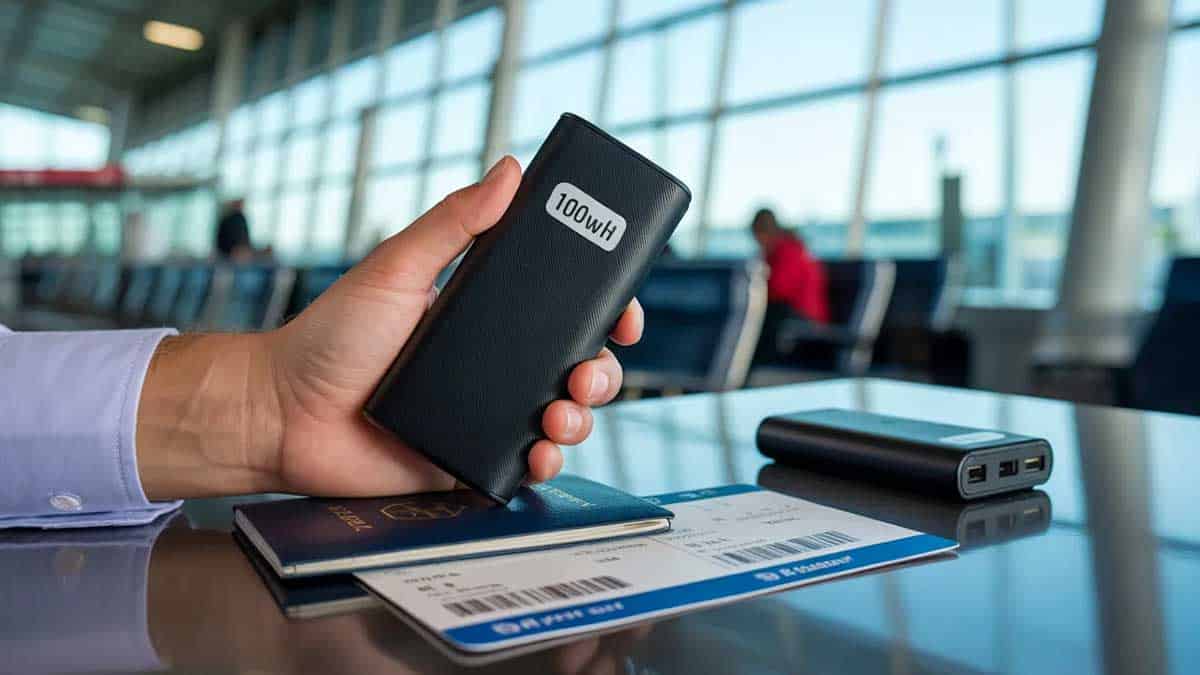
Summary:
- Two power banks max per passenger on SWISS and Lufthansa Group flights covered by the updated rule.
- No using a power bank during the flight, including charging devices from it or recharging it onboard.
- Keep power banks in cabin baggage, never in checked luggage.
- Know the capacity thresholds: 100 Wh is usually fine, 100–160 Wh can be conditional, over 160 Wh is commonly refused.
- A clearly labeled, reputable power bank is less likely to cause issues at security.
If your phone is your boarding pass, your map, your translator, your camera, and your entertainment, running out of battery is not a small inconvenience. That’s why most travelers pack a power bank without thinking twice, especially on long travel days with connections and delays.
But airlines don’t see a power bank as a gadget. They see a lithium-ion battery, and in the cabin that comes with strict rules. SWISS and Lufthansa Group have made their stance clearer since January 15, and the change is simple: bring fewer, and don’t use them in flight.
Why airlines are getting stricter about power banks
A power bank is essentially a compact lithium-ion battery. Most of the time it behaves perfectly, yet when a battery is damaged, poorly made, or simply worn out, it can overheat and fail fast. In a confined cabin, airlines prefer prevention over dealing with a rare but serious incident.
This is why the focus isn’t just “can you bring it” but also “what are you doing with it.” Every time you plug, recharge, or move a battery around, you increase exposure to the few situations that can go wrong. Airlines respond with rules that reduce those moments, and that’s exactly what this update targets: less quantity, less use.
What changed on SWISS and Lufthansa Group flights (January 15)
The headline rule is short and easy to remember: two power banks maximum per passenger, and no use during the flight. That second part is what catches frequent flyers off guard, because many people rely on a power bank to top up a phone at their seat.
In practice, “no use” means you shouldn’t charge your phone from your power bank once onboard, and you shouldn’t recharge the power bank using onboard power either. The safest approach is to board with everything already charged, then treat your power bank as a carried backup rather than an in-flight charger.
If you travel with multiple devices, phone plus earbuds plus tablet, this changes your routine. You’ll want one reliable battery instead of several small ones, and you’ll want to do most charging at the airport, not in the air.
The numbers that matter: 100 Wh and 160 Wh (and how to check yours)
Airlines often use watt-hours (Wh) to classify batteries. If your power bank clearly shows Wh on the label, you’re already ahead. The most common thresholds look like this:
| Capacity (Wh) | Typical airline stance | What you should do |
| Up to 100 Wh | Usually accepted in cabin baggage | Bring it, keep it protected |
| 100–160 Wh | Often conditional | Check airline policy before flying |
| Over 160 Wh | Commonly refused | Do not travel with it |
If your power bank only shows mAh, you can estimate Wh with a simple conversion: Wh = (mAh × V) / 1000. Many power banks use a nominal 3.7V, but don’t guess if you can avoid it. A clearly labeled device reduces confusion, and confusion is what creates gate problems.
One more detail matters: a power bank with vague markings or a suspicious brand is more likely to be questioned, even if it’s small. A well-known manufacturer and a clean label make your life easier, because the staff can identify the device at a glance.
The “no drama” checklist before you fly
Before you leave home, do the boring basics, they pay off. Charge your phone to 100%, charge earbuds and any secondary device, and pack one or two power banks at most. A single higher-quality unit is usually smarter than three cheap ones, because reliability and labeling matter more than raw capacity.
At the airport, use the waiting time to top up. Plug in at a lounge, a café, or a charging station, then board with a real battery buffer. Keep your power bank in a spot that’s easy to access in your carry-on, because a quick presentation at security is smoother than unpacking your entire bag.
Onboard, keep it simple: store the battery safely, don’t crush it under a heavy item, and don’t leave it in a place where it can overheat. If the airline applies a no-use rule, respect it and rely on device settings instead: airplane mode, low brightness, and offline content can stretch a phone far longer than most people think.
How to stay powered without using a power bank mid-flight
If you can’t plug into your power bank during the flight, you can still avoid the dead-phone scenario with a few habits. Download your boarding passes, maps, playlists, and videos before takeoff, then switch off background sync. That alone can save a surprising amount of battery.
Use battery saver mode early, not when you hit 10%. Keep your screen dim, close heavy apps, and avoid constant photo and video recording unless you really want it. Treat your phone like a travel tool, not a streaming box, and your battery will last longer.
If your aircraft offers seat power or USB ports and the airline allows you to use them, charging your phone directly can help. Just remember that some rules target power bank use specifically, so direct device charging is the cleaner choice when permitted.