
Summary
- Why Japan’s bullet train is more than speed.
- What the Shinkansen reveals about daily Japanese life.
- How to travel like a local and enjoy it.
- Where to catch that perfect glimpse of Mt Fuji.
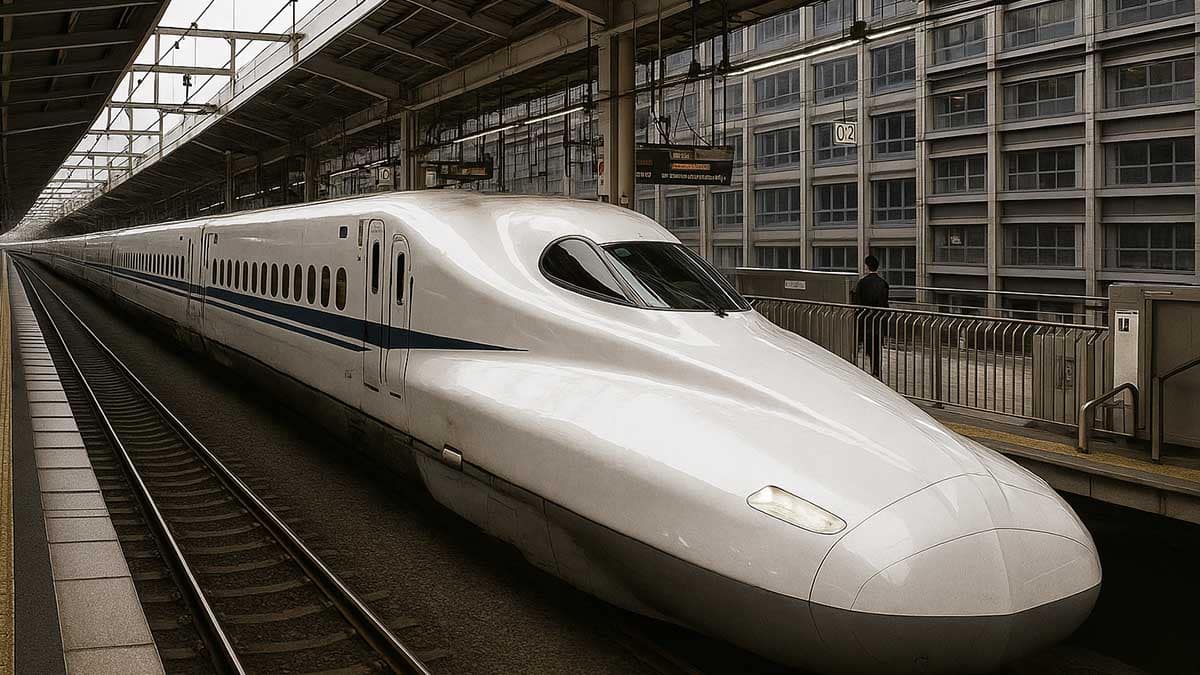
When you step onto a Shinkansen platform, the air changes. The noise softens, and people move in silent understanding. Lines form neatly, nobody pushes, nobody sighs. Within minutes, a sixteen-car train is emptied, cleaned, and ready to leave again. Every movement feels timed but never tense.
That is the secret of Japan’s railways: order without rigidity. The system is so polished that it feels alive, breathing in rhythm with its passengers. Punctuality here isn’t just about efficiency, it’s a quiet pact of respect. Everyone trusts the train to leave on time, and the train trusts everyone to be ready.
The Tōkaidō Shinkansen, connecting Tokyo and Osaka since 1964, is more than a line of steel; it’s a thread that stitches together the country’s pulse. Between urban skylines and farmlands, between business travelers and families, it reveals a Japan that moves quickly but never loses its calm.
The line that keeps Japan beating
Stretching 515 kilometers, the Tōkaidō route links Tokyo, Yokohama, Nagoya, Kyoto, and Osaka, carrying millions of riders every week. The fastest service, Nozomi, completes the trip in 2 hours 22 minutes, reaching 285 km/h. Yet the wonder lies less in the numbers than in the rhythm.
Through the window, the landscape tells stories in fragments: rooftops topped with laundry poles, schoolyards echoing with baseball games, tiny shrines tucked between houses. Sometimes a glimpse of the sea flashes by, then tunnels swallow the light. The transition from megacity to countryside happens seamlessly, a reminder that modern Japan still breathes with nature.
Each station along the way has its own pulse. In Kyoto, elegance and quiet reverence mix with movement. Nagoya hums with industry. Osaka vibrates with appetite and humor. And Tokyo, ever punctual, remains the starting point of a dance repeated thousands of times a day.
Trust built on precision
Ask a local what happens when a train is late, and they might laugh. Delays are so rare that when they occur, the crew apologizes with handwritten notes. Conductors bow before stepping into a carriage. The car attendant collects every piece of trash with care. Even the seats turn automatically to face the direction of travel, a small act of respect toward the journey itself.
This culture of precision is not obsession; it’s collective mindfulness. In the West, speed often means stress. Here, it means trust. When every person fulfills their role, time seems to cooperate. There is no shouting, no chaos. Only the steady hum of progress carried by discipline and empathy.
Travelers often describe the Shinkansen as “effortless,” and that’s perhaps its greatest achievement: making complexity invisible. You don’t think about logistics or control; you just flow inside the system, confident it will take care of you.
Local wisdom: how to ride like you belong
For first-timers, the Shinkansen can feel almost ceremonial, but the rituals are easy to learn.
- Book smart: use the Smart EX app or buy directly at any JR counter.
- Seat for Mt Fuji: choose seat E on the right when traveling from Tokyo to Osaka.
- Pack an ekiben: station bento boxes vary by region, try eel in Shizuoka or tofu in Kyoto.
- Mind your luggage: reserve space if your suitcase exceeds 160 cm total.
- Arrive early: ten to fifteen minutes is perfect, the train will leave on schedule.
Follow these unwritten rules, and you’ll blend right in. Locals appreciate travelers who observe the rhythm, who bow slightly to staff, who keep their voices low. You become part of the quiet choreography that makes Japanese railways feel almost human.
Stillness at 285 km/h
About forty-five minutes into the ride, Mt Fuji appears on the right side. On clear days, the mountain rises above the haze, snow shining like marble. The chatter fades. Even those lost in their phones look up. It’s a collective pause, a breath shared by hundreds of strangers.
For a moment, you realize this is more than transport, it’s an experience of stillness inside movement. The world outside races by, but inside the cabin, time stretches. You sip tea, unwrap your ekiben, and watch the countryside slide past like scenes from a film.
That calm is deliberate. The engineers designed the train to absorb vibration, to muffle sound. It’s speed engineered for peace. The faster you go, the smoother it feels, and that smoothness becomes almost meditative.
More than a train: a mirror of Japan’s soul
The Shinkansen is a reflection of the Japanese spirit, polite, precise, quietly proud. It does not boast, it simply works flawlessly. For visitors, it’s proof that efficiency can have warmth. For locals, it’s everyday life elevated to art.
Stepping off the platform in Osaka, you might glance back and see the train departing again. In less than ten minutes, it’s already headed toward Tokyo, repeating its ritual. It never truly rests, much like the nation it represents: in constant motion, yet perfectly balanced.
Traveling by Shinkansen isn’t about getting somewhere faster; it’s about seeing how a society treats movement, with patience, intention, and care.