
Summary:
- Why Spain is looking for a recognizable national symbol.
- What the 300-meter bull would actually include.
- Why choosing a location has become politically sensitive.
- How public opinion challenges the initiative.
- What this debate reveals about Spain’s tourism strategy.
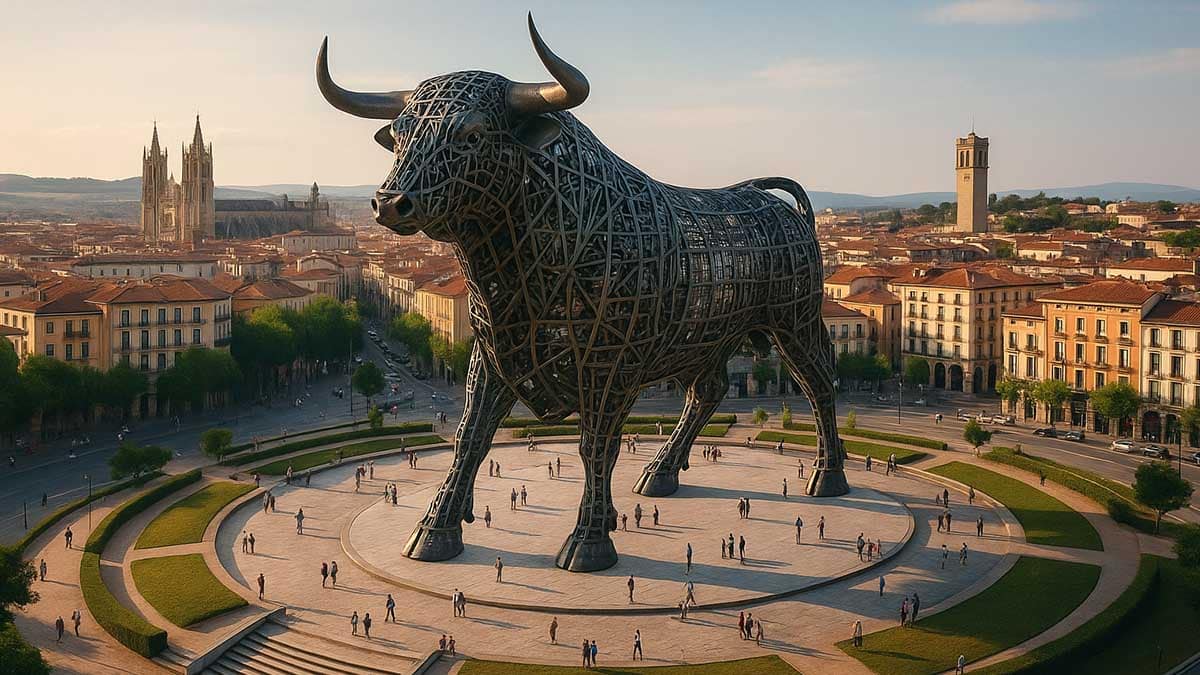
Spain welcomes millions of travelers each year, yet it does not have a single landmark that instantly identifies the country abroad. This observation pushed the Spanish Academy of Bullfighting to imagine something entirely unexpected: a giant steel bull as tall as the Eiffel Tower, designed as a walkable monument with viewpoints in its horns and a cultural park at ground level.
The idea sparked immediate controversy, with some seeing it as a chance to give Spain a signature icon, while others question the relevance of a monument tied to bullfighting. Environmental concerns and public priorities also feed the debate. In the sections below, we explore what the project includes, why it divides opinion and what it reveals about Spain’s future. Let’s dive in.
Spain wants an icon, but which one
Spain’s tourism strength comes from its variety: Mediterranean coastlines, Moorish architecture, Gaudí’s buildings and regional festivals. Supporters say that a unifying symbol could boost Spain’s visibility among destinations known for instantly recognizable landmarks.
Why the idea is gaining traction
- Spain wants a structure as visually striking as the Eiffel Tower.
- Cultural institutions argue the country lacks a single reference point.
- A national icon could reinforce the country’s tourism identity.
Traveler’s note
Monuments do not just attract visitors, they help shape how a nation presents itself to the world.
Inside the 300-meter bull, what visitors would see
The project imagines a steel mega-structure roughly twice the height of the Sagrada Familia. It would combine spectacle and cultural storytelling through interior walkways and a themed park.
What the structure includes
| Feature | Description |
| Height | 300 meters |
| Material | Steel |
| Visitor areas | Viewing platforms inside the horns |
| Ground zone | Cultural and educational themed park |
| Purpose | A distinctive national symbol |
A symbol with mixed meanings
The bull is deeply rooted in Spain’s cultural imagery. Yet for many Spaniards, its link to bullfighting clashes with modern values, which complicates the symbol.
Local tip
A well-designed park could highlight Spain’s landscapes, gastronomy and regional traditions, instead of focusing on bullfighting alone.
A country divided, support, skepticism and humor
Public reactions were immediate and polarized. Surveys show that a large majority of Spaniards oppose bullfighting, and some regions have banned it. As a result, many citizens feel the bull no longer represents the country today.
Arguments from supporters
- A major tourism opportunity.
- Spain deserves a global icon.
- The bull could be reframed in a cultural rather than bullfighting context.
Arguments from opponents
- The symbol feels outdated.
- Public funds should go toward more pressing needs.
- The environmental impact would be significant.
Certain critics joked about building a giant paella pan or a monumental sangria jug, questioning whether a bull truly represents Spain’s identity.
Environmental and financial questions
A structure of this scale raises concerns about land use, sustainability and long-term maintenance. None of these issues are settled.
A monument in search of a home
Finding a location is proving difficult. Madrid, often the natural candidate for national projects, rejected the idea. Local leaders say the bullfighting symbol does not reflect the city’s priorities.
Municipalities willing to consider it
- Burgos
- Guadalajara
- El Molar
These towns hope the monument could bring visibility and stimulate local economies.
Budget insight
A project of this magnitude would need strong institutional backing and a solid public-private funding partnership. Without national agreement, it remains speculative.
What this debate reveals about Spain’s tourism future
Whether the bull is built or not, it shows Spain wants to refine its global narrative. The country already excels in food culture, architecture, festivals and landscapes, which attract visitors year-round. But none of these elements act as a single visual signature.
The debate raises a simple question, should Spain adopt an emblematic structure, or rely on its wide diversity of experiences? For now, the giant bull remains an idea, but it has already opened a meaningful conversation about identity and ambition.
The 300-meter bull is more than a design concept. It reflects Spain’s ambitions, doubts and internal debates. It raises questions about symbolism, relevance and cost, while pushing the country to consider how it wants to present itself internationally. The final icon may look different, or never exist, but the conversation it opened is already shaping Spain’s narrative.
Curious how other destinations build their identity through architecture and culture? Explore more stories here.