
Summary:
- Where Chefchaouen’s blue tradition really comes from, beyond the stories.
- How to walk the medina without turning it into a photo checklist.
- What changes once you stay past sunset.
- Why the surrounding mountains matter as much as the streets.
Chefchaouen doesn’t create an instant shock. There is no chaos at the gate, no sensory overload. You enter the town almost without noticing it, through a curve in the road, then a few quiet streets, and suddenly the blue begins to appear.
Most travelers arrive with images already in mind. Blue stairs, painted doors, soft light. What often comes as a surprise is everything around those images: the silence between steps, the ease of walking without purpose, the feeling that nothing is pushing you forward. This article looks at Chefchaouen as it is experienced, not consumed.
A blue that doesn’t need one single explanation
Ask ten people in Chefchaouen why the city is blue, and you will likely hear ten slightly different answers. None of them cancel the others out, and that ambiguity is part of the city’s local identity.
Some stories point to the Jewish community that settled here in the last century, where blue symbolized faith and the sky. Others speak more simply of comfort: cooler walls, softer light, fewer insects. Over time, the color became a shared signature, maintained because it felt right, and because it made the town recognizable.
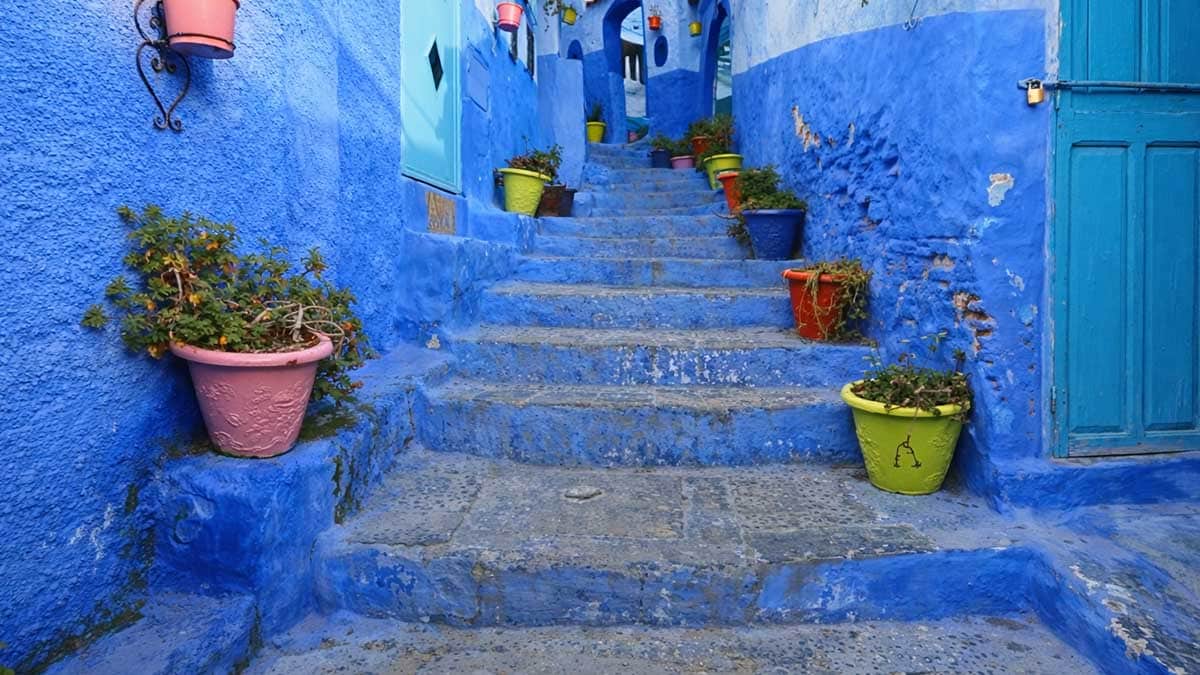
What matters today is less the origin than the result. The blue is not uniform. It fades, deepens, and shifts from one street to the next. Doors, steps, and flower pots are repainted when needed, often without coordination, giving the medina a lived-in texture.
A quiet detail worth noticing
Early morning light reveals the texture of the walls: cracks, brush marks, layers of paint. This is when the city feels most unfiltered.
Getting lost is the point of the medina
Chefchaouen’s medina is small enough to feel approachable, yet complex enough to reward wandering. You do not need a map here, and in many ways, it is better without one.
Some alleys are clearly prepared for visitors, with decorative setups and familiar angles. Walk a few minutes uphill and the tone changes. Fewer voices. More daily life. A neighbor sweeping a doorstep. A cat asleep in the shade.
Landmarks exist, but they do not dominate the experience:
- Outa el Hammam Square, lively but not overwhelming.
- The Kasbah, modest in size, useful mainly for its views.
- Upper residential streets, where the city feels more intimate.
Cats move freely through it all, unbothered by cameras or footsteps. In Chefchaouen, they do not perform. They simply belong.
A simple rule that helps
If a street feels crowded, keep walking. The medina always opens again, usually within minutes.
Stepping outside the blue, nature around Chefchaouen
Chefchaouen’s calm does not stop at the city limits. The mountains begin almost immediately, and with them, a slower rhythm.
Akchour and the river walks
About an hour away, Akchour offers one of the region’s most accessible outdoor escapes. The path follows a river, sometimes narrow, sometimes wide, with pools forming naturally along the way. You decide how far to go.
| Destination | Walking time | Effort | Best for |
| Small pools | Short | Easy | A relaxed break |
| God’s Bridge | Medium | Moderate | Scenic walking |
| Upper waterfalls | Long | Moderate | Full-day outing |
Beyond Akchour
- Gentle climbs toward Jebel el Kelaa for open views.
- Forested trails in Talassemtane National Park, quieter and less marked.
These places are not about performance or distance. They follow the same logic as Chefchaouen itself: walk, stop, continue if you feel like it.
Staying long enough to feel the city change
Chefchaouen works as a day trip, but it makes more sense as an overnight stop. Once the buses leave, the city exhales.
Shops close early. Streets empty. Voices drop. What remains is a town returning to its own rhythm.
Practical notes
- Connections by bus or shared taxi from Tangier, Fes, or Tetouan are straightforward.
- Guesthouses inside the medina offer the most authentic atmosphere, especially in the early morning.
- Spring and autumn are comfortable, but timing your day matters more than the season itself.
Chefchaouen does not reward rushing. It rewards stillness.
Chefchaouen is not a place to conquer or complete. Its appeal lies in what it does not demand from you.Walk slowly. Stay overnight if you can. Let the blue become a background rather than a subject. What you will remember is not a color, but a sense of space, one that quietly follows you home.