Show summary Hide summary
Summary:
- Why Maya sites feel so different from one another.
- What each city reveals about power, movement and daily life.
- How to visit these places without turning them into a checklist.
- What travelers often miss when they rush through the ruins.
Most travelers arrive with the same image in mind before visiting a Maya site, a pyramid rising from dense jungle, framed by palm trees and open sky. It is a striking picture, but also a partial one. Maya cities were built for very different purposes, shaped by geography, trade and belief rather than by a single architectural model.
Visiting these places today is not just about admiring stonework or famous names. It is about understanding how people organized their world, long before modern borders or tourism routes existed. This guide looks at major Maya sites in Mexico from that angle, focusing on what makes each one distinct and how travelers can approach them with more context and intention.
Bhutan: the country that quietly slows you down (and you’ll thank it for)
Europe in 2026: the trips worth planning around real dates
When land and sky dictated how cities were built
Maya cities were never placed randomly. Their location followed practical needs, such as access to water or fertile land, as much as symbolic ones tied to seasons and celestial cycles. Architecture was a response to the environment, not an attempt to dominate it.
The Maya world was not unified under a single power. Independent city-states developed their own identities, alliances and rivalries. This diversity is still visible today, in the layout of cities, in inscriptions and in the way space was organized. It also explains why visiting several sites never feels repetitive.
What this means for travelers:
- Every site reflects a specific landscape and political role.
- Distances between cities often follow ancient connections.
- The surrounding environment is part of the visit, not a backdrop.
Famous Maya cities, beyond the postcard version
Chichen Itza, more than a single pyramid
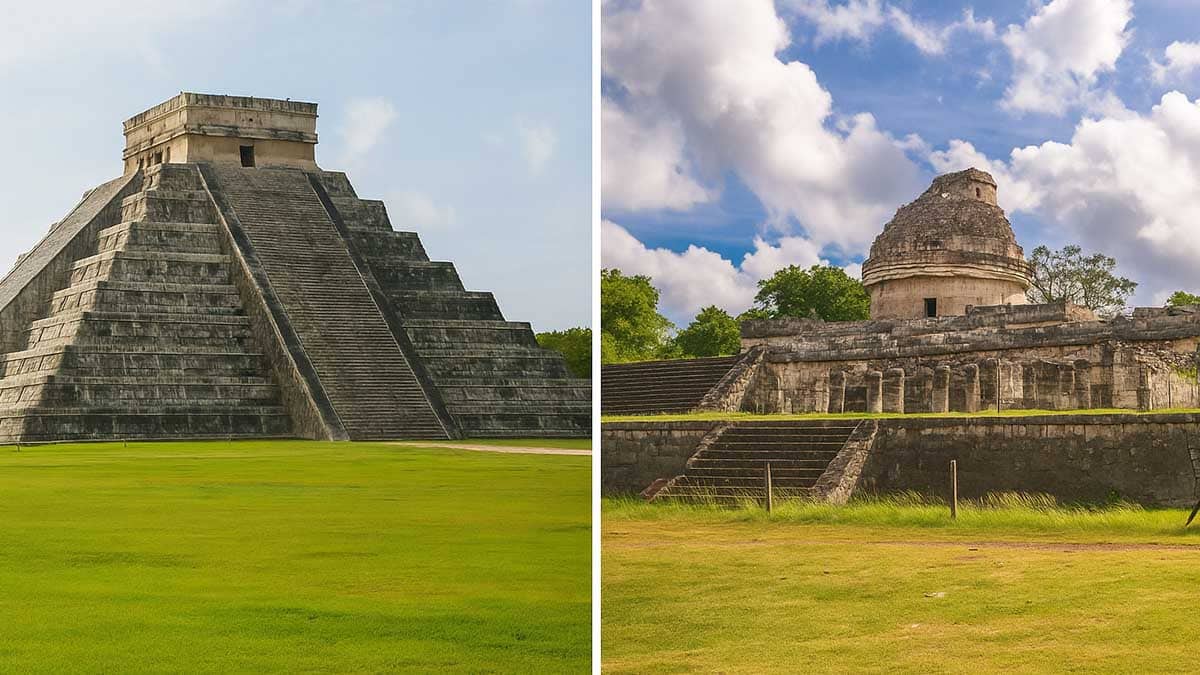
Chichen Itza is often reduced to El Castillo, its iconic pyramid. In reality, the city functioned as a regional crossroads, where different cultural and political influences met. Its architecture reflects exchanges across the Maya world rather than a single local style.
The Great Ball Court is a good example. It was not built for entertainment alone, but for rituals linked to authority and cosmic order. Seen this way, Chichen Itza feels less like a monument and more like a former capital that once managed people, ideas and power.
Tulum, a city turned toward the sea
Tulum stands apart because of its relationship with the ocean. Built on cliffs above the Caribbean, it controlled maritime trade routes rather than inland roads. Defensive walls, uncommon in Maya cities, protected both goods and strategic knowledge.
Today, the setting draws large crowds. Yet the real interest lies in understanding how coastal trade shaped the city’s role. Tulum reminds visitors that the Maya were active participants in regional exchange networks, not isolated inland societies.
Palenque, where power was written in stone
Hidden in the forests of Chiapas, Palenque feels more intimate than many other sites. What it lacks in scale, it makes up for in detail and precision. Hieroglyphic inscriptions have allowed historians to reconstruct dynasties, conflicts and beliefs with unusual clarity.
Here, writing was central to authority. Stone reliefs served as political memory, designed to legitimize rulers and preserve their legacy. Visiting Palenque is less about spectacle and more about reading a city that wanted to be understood.
Deep jungle capitals that time almost forgot
Calakmul, the quiet rival
Reaching Calakmul takes time and effort. Located deep inside a biosphere reserve, the site remains deliberately remote, far from major roads. This isolation mirrors its historical role as one of the most powerful Maya capitals.
Calakmul ruled through alliances rather than direct conquest. Thousands of structures remain hidden beneath vegetation, and wildlife is part of the experience. The city feels unfinished, as if history and nature are still negotiating control of the space.
Cobá, the city connected by roads
Cobá tells a different story. Its influence came from movement. An extensive network of sacbe, raised stone roads, connected the city to distant settlements. These were practical routes used for trade, administration and control.
Climbing the Nohoch Mul pyramid offers a rare perspective. The forest stretches endlessly in every direction, making it easier to imagine how this city once stood at the center of a vast network now invisible.
How to plan a route that feels meaningful, not rushed
Visiting multiple Maya sites requires more than calculating distances. Climate, access and crowd levels vary widely, and timing can change the entire experience.
When to go
- The dry season, from November to April, offers more comfortable conditions.
- Early mornings mean cooler temperatures and fewer visitors.
- Remote sites are best visited at sunrise, when the environment feels most alive.
Practical overview
| Site | Region | Access | Best moment |
| Chichen Itza | Yucatán | Easy | Early morning |
| Tulum | Quintana Roo | Easy | Opening hours |
| Palenque | Chiapas | Moderate | Mid-morning |
| Calakmul | Campeche | Difficult | Sunrise |
| Cobá | Quintana Roo | Moderate | Late afternoon |
Traveler’s note:
Mix well-known sites with lesser-visited ruins nearby. It balances intensity and keeps curiosity intact.
Why these places still matter today
Maya ruins are not frozen in time. They coexist with modern towns, languages and traditions that have endured for centuries. In many regions, cultural continuity is visible in daily life, not just in museums.
Reynisfjara right now: what changed on Iceland’s black sand beach
Europe’s 2026 travel shortlist: Madeira, Tbilisi, Milan, Glasgow
For travelers, this adds depth. These sites invite reflection on how societies adapt, manage space and think long-term. Approached with patience rather than speed, they offer more than images. They offer perspective.
Exploring Maya sites in Mexico is not about collecting landmarks. It is about understanding how different cities answered the same questions, each in its own way. How to rule, how to trade, how to live with the land.Take time to walk slowly and look beyond the obvious. Southern Mexico still rewards attentive travelers, those willing to listen rather than rush.