
Summary:
- Why Seoul grows by adjustment rather than strict planning.
- How architecture reflects speed, pressure, and short memory.
- Where older neighborhoods quietly resist change.
- Why daily scenes often say more than landmarks.
- How to experience Seoul without trying to fully explain it.
Seoul can unsettle even seasoned travelers. Streets change direction without warning, towers rise where nothing seems to anchor them, and neighborhoods rarely behave the way their reputation suggests. The city does not ease you in. It asks you to pay attention and accept a certain loss of control.
Rather than presenting a clear identity, Seoul reveals itself through fragments. Its form, its buildings, and its daily rhythm tell the story of a place shaped by movement rather than order. Understanding it often means letting go of the need for clarity and learning to read what unfolds along the way.
A city that follows the land before the plan
Seoul did not grow around symmetry or long-term visual harmony. Its expansion followed valleys, rivers, and mountain lines, influenced in part by pungsu, a local way of thinking about space that favors circulation and balance over rigid geometry.
As flat land disappeared, the city turned upward. What emerged is a skyline that feels uneven but decidedly alive, where districts evolve at their own pace and for their own reasons. Planning exists, but it remains flexible, leaving room for correction rather than perfection.
What this means when you walk the city
Getting lost in Seoul is common and rarely frustrating. Detours often make more sense than routes, and the city tends to reveal itself when you stop trying to read it too precisely.
Gangnam and the art of building fast
Gangnam is often described as Seoul’s polished face, yet it also exposes how quickly the city replaces itself. A few decades ago, this area was still open land. Today, it concentrates luxury brands, corporate headquarters, and architecture designed to make an immediate impression.
Many buildings are conceived for a single viewpoint. Walk around them and you may find unfinished sides, or exposed concrete. Longevity is rarely the priority. What matters is presence and visibility, and the ability to move on when needed.
| District | What came before | What it became |
| Gangnam | Farmland | Finance and luxury |
| Dongdaemun | Stadium area | Design and culture |
| Yeouido | Riverside land | Offices and public parks |
Offices that quietly structure daily life
Office buildings in Seoul often hide dense interior worlds. Tech companies and large groups design spaces meant to absorb long hours, with cafés, shared areas, and internal services folded into the building itself.
Outside, the city softens but never fully slows. Parks, galleries, and cafés offer brief pauses, not clear separations. Work does not dominate the landscape visually, yet it shapes schedules and habits throughout the day.
Local note
Public spaces are rarely empty. People work, talk, eat, and wait in the same places, without clear transitions between one activity and the next.

Dongdaemun, where contrast stays unresolved
Dongdaemun Design Plaza stands where a stadium once did. Its smooth metal curves feel almost detached from the surrounding streets, yet it sits next to markets filled with fabric stalls and the smell of hot food.
Nearby, the Leeum Samsung Museum of Art brings together buildings by different architects, each offering a distinct approach to space. Inside, light, stone, and glass create moments where nature appears quietly, framed rather than staged.
Nothing here tries to reconcile the differences. The contrast remains visible, left unresolved on purpose.
Street scenes that hold everything together
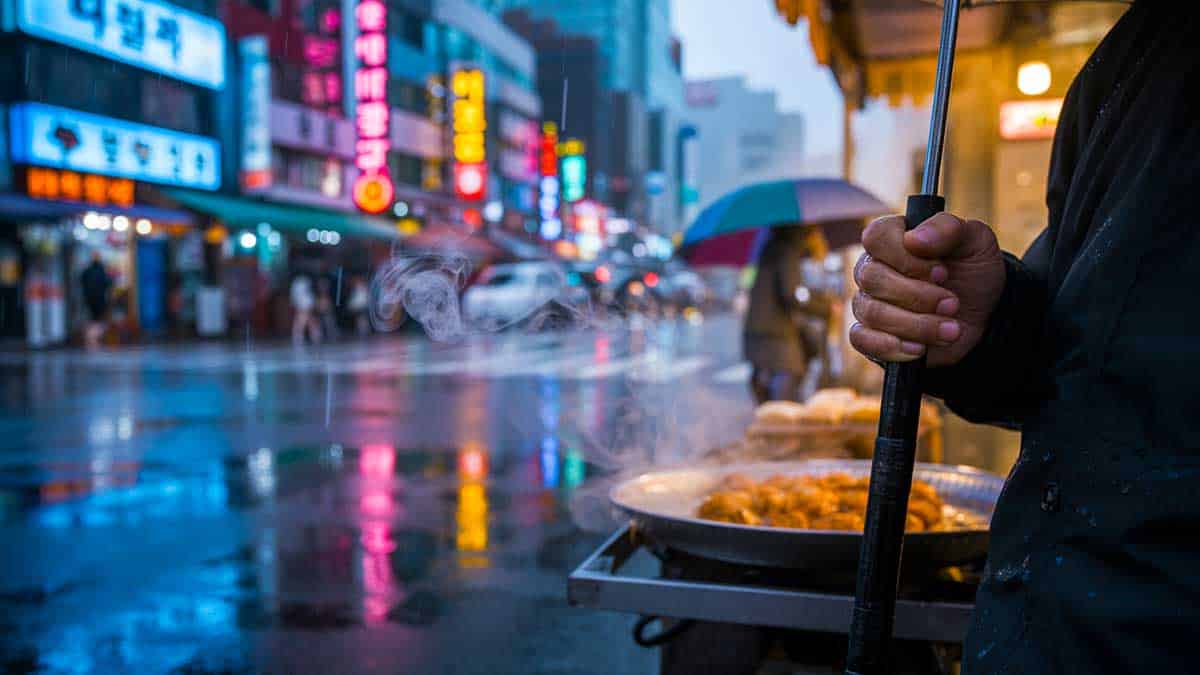
Away from major sites, Seoul reveals itself through small, unplanned moments. Sidewalks become waiting rooms, food stalls, parking spaces, or meeting points. During the rainy season, people walk through heavy downpours without urgency, letting the city set the pace.
Traditional hanok neighborhoods still survive, compressed and fragile. They feel out of time, but not out of place. Their modest scale and restraint offer a quiet counterpoint to constant rebuilding.
Seoul does not aim for coherence. It moves forward by accumulation, leaving traces visible rather than hidden. Understanding the city comes less from analysis than from sustained attention.It starts to make sense when you stop asking it to settle. Seoul rewards those who observe before judging.