

Summary:
- Asia-Pacific takes 9 of the top 10 busiest air routes worldwide in 2025.
- Jeju–Seoul remains the world’s number one route with 14.4 million seats.
- OAG highlights a key detail: the load factor is still 17% below 2019 levels.
- Japan stays prominent because its domestic routes are steady, high-volume, and structural.
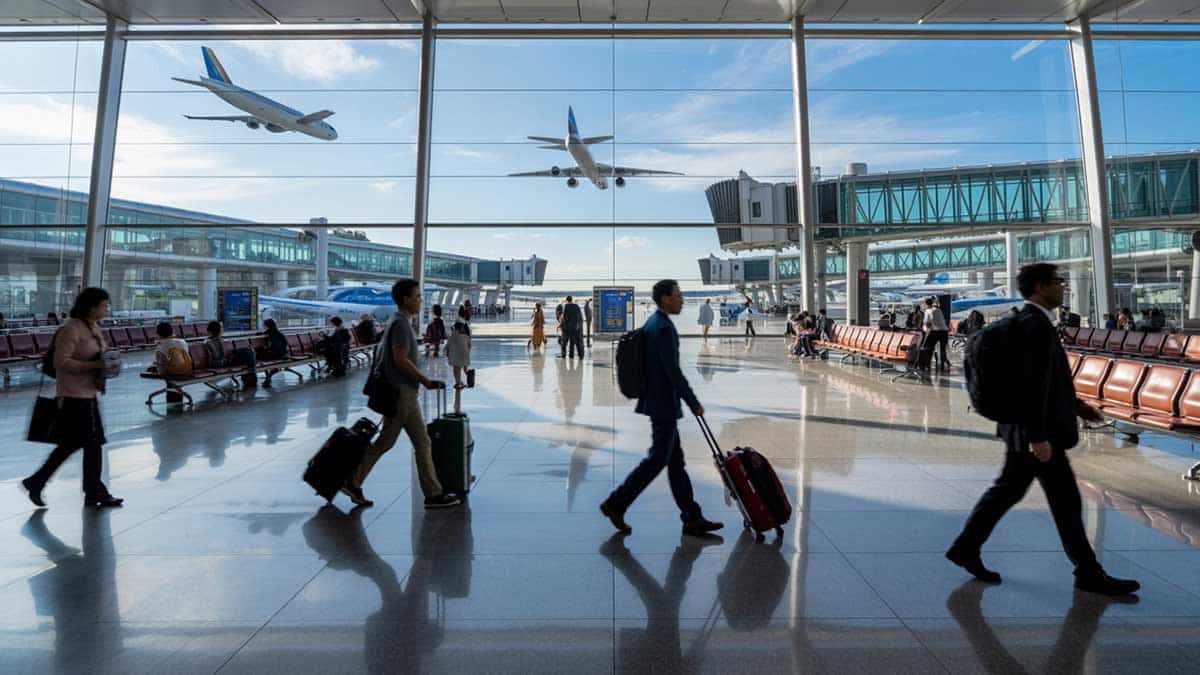
If you’ve flown around Asia in 2025, you probably felt it. On some routes, planes don’t show up “from time to time”. They line up one after another, creating a rhythm that feels almost like public transport. Fast turnarounds, busy terminals, and flights that seem to run all day without pause.
OAG’s 2025 ranking puts numbers on that reality. Nine of the ten busiest air routes in the world are in the Asia-Pacific region, mostly short-haul domestic corridors. This isn’t just tourism momentum. It’s everyday mobility at scale. Here’s what the ranking reveals, and why these routes dominate so strongly.
Asia-Pacific doesn’t just appear, it dominates the top 10
The main message from OAG’s 2025 ranking is straightforward. Asia-Pacific concentrates the bulk of global seat volume on the world’s busiest routes. Taking nine spots out of ten in the top 10 is not a small lead, it’s a clear indicator of where aviation is most intense right now.
This isn’t caused by one “hot” destination. These routes share the same profile. They are typically short to mid distance, they operate at very high frequency, and they’re powered by massive domestic demand. They connect major hubs to places people travel to constantly, for work, family visits, and quick getaways.
In other words, these flights aren’t optional. They function as daily infrastructure, which explains why they stay strong even when international travel rises and falls.
Jeju–Seoul stays number one, but the real story is in one detail
South Korea’s Jeju–Seoul route keeps its global crown in 2025. OAG reports 14.4 million seats, up around 1% year over year. The scale is enormous, and it remains stable enough to hold the top spot.
But OAG adds a detail that changes how you read the ranking. The route’s load factor is still 17% below its 2019 level. In simple terms, capacity is high, but planes aren’t as full as they used to be, at least not compared to the pre-2019 benchmark.
That’s why “busiest” can be misleading. It doesn’t automatically mean “fully recovered”. It can also mean airlines keep supply high to protect a key corridor, even if demand hasn’t completely caught up. On a route this large, that approach can still keep it at number one.
Japan stays in the mix because domestic flying is structural there
Japan also shows up in OAG’s ranking through major domestic routes. If you’ve ever looked at Japan’s geography, it makes sense. Some city pairs are far enough that air travel remains a core option for regular movement.
What stands out is stability. Japan’s domestic corridors rest on strong fundamentals: large population centers, long internal distances, and a constant travel rhythm. The country doesn’t need seasonal tourism spikes to keep these routes busy. It has a steady baseline of internal mobility.
As a result, these routes run at scale all year. They operate as permanent high-volume corridors, not just holiday-heavy seasonal lines.
What the ranking really says about air travel in 2025
If you zoom out, the message is clear. Global air traffic volume concentrates on high-frequency domestic routes in Asia-Pacific. That challenges the old idea that “big aviation” mainly means long-haul international flights.
In 2025, the busiest routes are often the ones built around everyday life. They are repeated, practical, and essential, which is exactly what creates volume.
Here’s the recurring pattern behind these top corridors:
| What these routes share | What it implies |
| Short flights with very high frequency | A shuttle-like rhythm throughout the day |
| Strong domestic demand | Less dependence on international recovery |
| Geography that favors flying | Alternatives can be slower or limited |
| Hub-to-hub structure | Airlines can densify operations efficiently |
Once you see those ingredients together, Asia-Pacific’s dominance starts to look almost inevitable.
What it means for travelers: routes that behave like high-frequency transport
For travelers, this ranking isn’t just aviation trivia. It explains why some domestic routes in Asia feel like nonstop movement. On the biggest corridors, flying is often the “normal” option, not the special one.
In practice, that usually means schedules spread across the day, constant rotations, and routes treated as top priorities by airlines. Everything is designed to keep traffic flowing.
And if you’ve flown one of these routes, you probably understood it before you ever saw a ranking. OAG simply confirms it with numbers: on these corridors, movement never really stops.
OAG’s 2025 ranking confirms that Asia-Pacific carries the strongest air-route volume in the world, largely through domestic corridors running at very high frequency. Jeju–Seoul remains the most striking example, while Japan’s presence highlights how stable and structured domestic flying remains there.
If you want a snapshot of where air travel is most intense in 2025, it’s not necessarily a famous long-haul route. It’s a short flight people take again and again, because it simply fits everyday life.